

In the world of dressage, technique is essential. The position, the aids, the precision of every movement — we work on these elements every day. But there’s something that truly sets a good rider apart from a great one: the ability to understand their horse.
A good rider knows how to ride.
But the best rider is the one who observes, who feels, who asks why their horse is more tense today, why he’s hesitant to go forward, why he doesn’t respond the same as yesterday.
The best rider listens — even though the horse speaks no words.
Every horse has a story, a personality, a unique sensitivity. Some are bold and confident; others are shy, insecure, or more reactive. Some learn quickly; others need time and patience. And it’s not our job to force them into a mold, but rather to adapt, to communicate, and to build a relationship based on mutual trust.
And here’s something we often forget:
Horses don’t lie. They simply don’t have that ability.
They don’t pretend, manipulate, or make things up.
So when a horse acts out, resists, shuts down, or reacts — there’s always a reason.
The problem isn’t the horse.
The problem is often that we don’t know how to read him.
It’s easy to label a horse as “difficult” or even “a bastard” — a phrase we sadly still hear far too often in the equestrian world.
But behind every reaction, there’s a cause: pain, fear, confusion, frustration… or simply a cry for help.
They don’t speak, but they express everything with their eyes, with their body, with tension or stillness, with the way they move or refuse to move.
It’s up to us to learn their language.
Understanding a horse means asking the right questions:
- Does he need a softer ride today?
- Maybe a hack in the field to relax?
- Is something off with his saddle, bridle, or body?
- Is his living situation affecting his mood?
Horses don’t fake it. If something’s not right, they show it — not with words, but with signs we must learn to see and interpret.
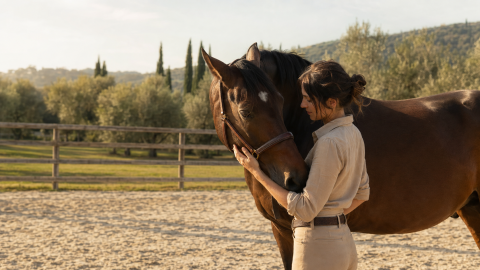
When we take the time to look into their eyes and truly see them, the communication becomes real.
At Gallery Horse
We love dressage — but more than that, we love horses. And we deeply believe that great riders aren’t just made in the arena. They’re shaped in the stable, in the everyday details, in quiet observation, in respect. Because those who take the time to understand their horse often end up understanding themselves.
This post is for those who want to go beyond technique.
For those who ride with their soul.
For those who see their horse not as a tool, but as a partner.
Because that’s the foundation of real horsemanship.