

When assessing a dressage horse, we tend to focus first on the qualities that are easiest to see: the quality of its gaits, its conformation, bloodlines or level of training. Yet there is a less visible quality that can shape the horse’s entire sporting career: its character.
But is a horse born with a particular character, or do we help to create it?
The answer is not entirely straightforward. A horse is born with its own temperament, but many of the behaviours it develops throughout its life will be influenced by its experiences, education, environment and, above all, by the way people interact with it.
Temperament and character are not exactly the same
Every horse is born with certain natural predispositions. Some are more curious and trusting, while others are more cautious, sensitive or reactive. Some horses seem able to adapt easily to almost any situation, while others need more time to understand what is happening around them.
That is part of their temperament.
Character, however, is shaped over time. It develops through daily handling, training, relationships with other horses and all the positive and negative experiences the horse accumulates throughout its life.
This is why two horses with similar temperaments can develop very differently depending on how they have been raised and trained.
Early experiences leave a lasting impression
The first years of a horse’s life are enormously important. A young horse raised in a stable environment, with social contact, freedom of movement, consistent routines and respectful handling, learns to trust and to approach the world with greater confidence.
By contrast, an education based on excessive pressure, haste or inconsistency can create insecurity, resistance and fear.
We often describe a horse as “difficult”, “dominant” or “uncooperative” without asking ourselves what experiences may have caused that behaviour.
A horse does not simply decide one morning to become difficult. Quite often, what we interpret as a character flaw is a learned response to situations that have previously caused pain, confusion or fear.
Training also shapes character
Good training does not only develop the horse’s body. It educates the mind as well.
When training is progressive, understandable and fair, the horse learns to search for answers, face new challenges and trust the person guiding it. Gradually, it develops confidence, concentration and a willingness to cooperate.
However, when the demands placed on the horse repeatedly exceed its physical or mental capacity, frustration may arise. The horse may begin to anticipate, defend itself or mentally disengage because it does not understand what is expected or feels that it can never find the correct response.
Dressage should make a horse more confident, not more fearful; more trusting, not more submissive.
Does a sensitive horse have a bad character?
This is one of the most common misinterpretations.
Sensitivity is not a fault. In fact, many great dressage horses are extremely sensitive. They respond to the smallest aids, learn quickly and notice almost imperceptible changes in the rider’s balance or position.
But that same sensitivity requires accuracy, calmness and experience.
In the right hands, a sensitive horse can become an extraordinary partner. In an environment that does not understand its needs, it may appear nervous, difficult or unpredictable.
Therefore, it is not enough to decide whether a horse has a “good” or “bad” character. We need to ask whether its sensitivity, energy and way of reacting are compatible with the experience, goals and personality of its future rider.
Not every behavioural problem is a character problem
Before judging a horse by its behaviour, it is essential to rule out pain or physical discomfort.
A horse that resists the contact, is reluctant to move forward, suddenly changes its attitude or begins to defend itself during certain exercises may be trying to communicate something.
Dental problems, back pain, an ill-fitting saddle, injury, fatigue or even inappropriate feeding and living conditions can completely transform a horse’s behaviour.
Labelling the horse as difficult too quickly may prevent us from identifying the real cause.
Behaviour is information. We must learn to observe it before we judge it.
The rider is also part of the character we see
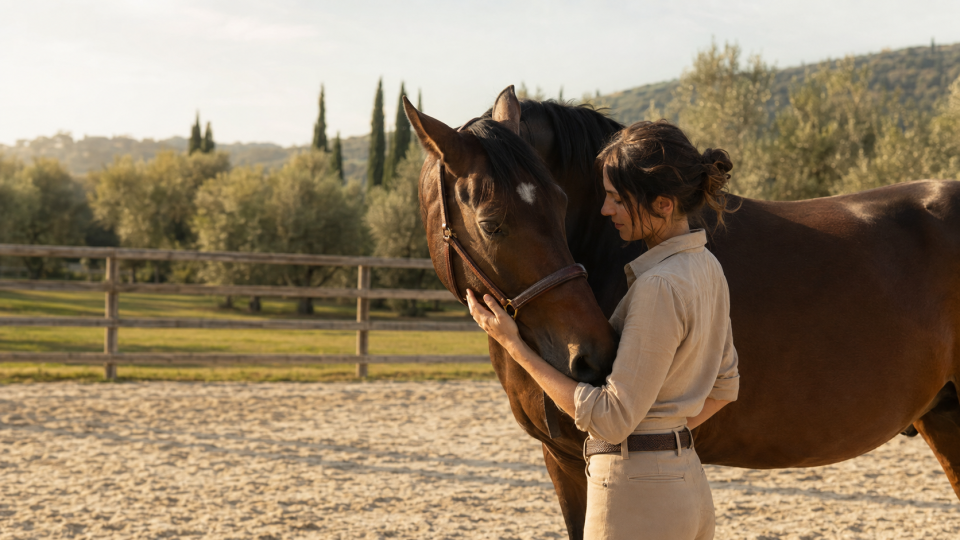
The same horse can behave very differently with two different riders.
With one rider, it may appear tense, insecure or defensive; with another, relaxed and willing to cooperate. This does not necessarily mean that one of them is a bad rider, but rather that every partnership creates a different form of communication.
Horses sense our tension, clarity, patience and inconsistencies. They learn what they can expect from us and adjust their responses accordingly.
That is why, when buying a horse, we are not only assessing its individual qualities. We are also trying to anticipate the relationship it may build with a particular person.
Can a horse’s character be changed?
We cannot completely change a horse’s nature. A particularly sensitive horse will probably remain sensitive, just as a naturally energetic horse will retain its vitality.
But we can help a horse manage its emotions, strengthen its confidence and develop a more cooperative attitude. We can also do the opposite: turn sensitivity into fear, energy into tension and caution into mistrust.
A horse’s character is not created from nothing, but it is shaped every day.
Every experience leaves a mark. Every training session can strengthen the horse’s confidence or weaken it. Every person who passes through its life contributes, in some way, to the horse it will eventually become.
Character is also a form of talent
In dressage, talent is not found only in spectacular movement. It can also be seen in a horse’s ability to learn, its generosity in trying again, its emotional stability and the trust it is capable of building with its rider.
Movement may impress us for a few minutes. Character is what allows a partnership to develop over many years.
When assessing a horse, therefore, we should not only ask how far it might go. We should also consider how it will travel that journey—and with whom.
Finding the right horse is not about looking for a perfect animal. It is about understanding its nature, knowing its history and discovering the rider with whom it can become the best version of itself.