

In today’s dressage market, movement sells.
- Big front legs.
- Huge suspension.
- Powerful presence.
- Videos that capture attention in seconds.
But after years working in the international dressage market — and from my perspective as a dressage judge — I can say this clearly:
Flashy movement is not the same as quality.
And it is rarely what helps an amateur rider progress safely and consistently.
If you are searching for the best dressage horse for an amateur rider, this is what you truly need to understand.
Why Flashy Horses Are So Attractive
When trying horses, many amateur riders are naturally drawn to:
- High front leg action
- Large, expressive trot
- Powerful uphill canter
- Horses that immediately “stand out”
There is nothing wrong with appreciating expressive movement.
However, impressive movement does not automatically mean correct biomechanics or long-term rideability.
And that is where many purchasing mistakes begin.
What Dressage Judges Actually Look For

As a judge working under FEI principles, I do not ask:
“Is this spectacular?”
I ask:
- Is the rhythm pure and regular?
- Is the energy truly coming from the hind legs?
- Is the back elastic and swinging?
- Is the contact steady and honest?
- Is the horse in real balance?
The classical training scale remains the foundation of dressage:
- Rhythm
- Relaxation
- Contact
- Impulsion
- Straightness
- Collection
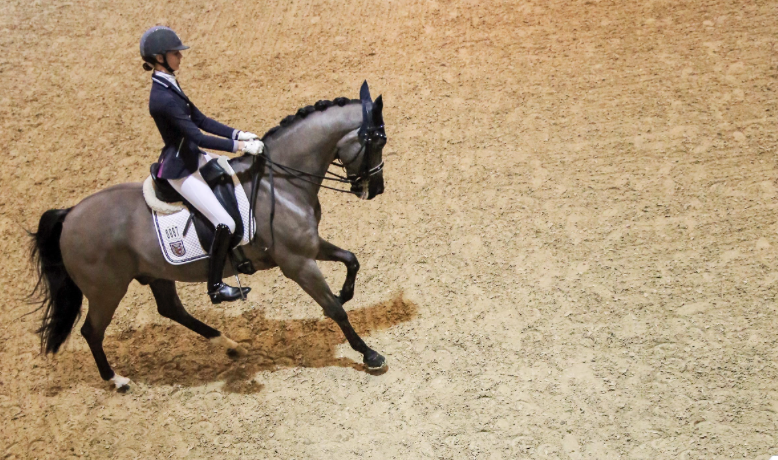
A huge trot without true rhythm loses marks.
A spectacular piaffe without clear diagonal steps loses marks.
A powerful extended trot without balance loses marks.
Judges reward correctness and consistency — not exaggeration.
The Risk for Amateur Riders
For amateur riders, choosing a flashy but unstable horse can create serious challenges.
If the horse:
- Lacks a solid basic rhythm
- Has tension in the back
- Is inconsistent in contact
- Requires constant physical strength to maintain balance
The rider ends up compensating.
Compensation leads to tension.
Tension leads to insecurity.
And insecurity blocks progress.
Many amateurs do not lack talent.
They lack a horse with a solid base.
Why a Correct, Consistent Horse Is Often the Better Investment
A less spectacular horse with:
- Three clear and regular gaits
- Honest contact
- Good hind leg activity
- Progressive, age-appropriate training
- Mental stability
Will often allow an amateur rider to:
- Develop confidence Improve seat and balance
- Compete more consistently
- Achieve more stable scores
- Enjoy the daily training process
In competition, harmonious and correct combinations frequently score better than expressive but tense ones.
Consistency wins over drama.
How to Choose the Right Dressage Horse
If you are buying a dressage horse as an amateur, ask yourself:
- Can I organize this horse’s energy without tension?
- Does the horse help me, or do I constantly hold everything together?
- Is the rhythm stable even in transitions?
- Could I ride this horse confidently on an ordinary training day — not just in a perfect trial setting?
The right horse should allow you to build, not survive.
Our Philosophy at Gallery Horse
At Gallery Horse, we work primarily with adult amateur riders who are passionate about dressage and want to grow safely and sustainably.
Our responsibility is not to present the most spectacular horse.
Our responsibility is to evaluate:
- The quality of the basic gaits
- The solidity of the training
- The mental balance of the horse
- The real compatibility with the rider
Sometimes that means recommending a horse that is less flashy — but far more correct.
Because long-term progress depends on foundation.
Final Thought
In dressage, the base is everything.
True quality does not shout.
It sustains.
And for an amateur rider, the best dressage horse is not the one that impresses everyone watching.
It is the one that allows you to breathe, grow, and enjoy the journey for years to come.
If you would like guidance in selecting a dressage horse that truly matches your level and long-term goals, Gallery Horse is here to help.